Not many things in the world are as enjoyable as a serene summer evening in the rural middle of nowhere. Stars shining in the sky. Smell of manure mixed with lavender and freshly cut grass. Dog barking three farms over, warm bottle of beer you nearly forgot about and the phone left inside the house where it cannot bother you anymore. And underneath all of it, the omnipresent hum of crickets.
I went into this metaphor sure that locusts were an emergent property of too many crickets per square meter. Turns out, they aren't. Those are grasshoppers, which come from the same orthopteran family and that is just about where the similarities end. Crickets are nocturnal, dark-coloured omnivores. Grasshoppers are diurnal, green herbivores. Locusts are grasshoppers you really, really shouldn't seat too close together at the wedding. Pretty evening sounds come from crickets, but the metaphor has already been chosen so I won't be bothered with some biological nuance.
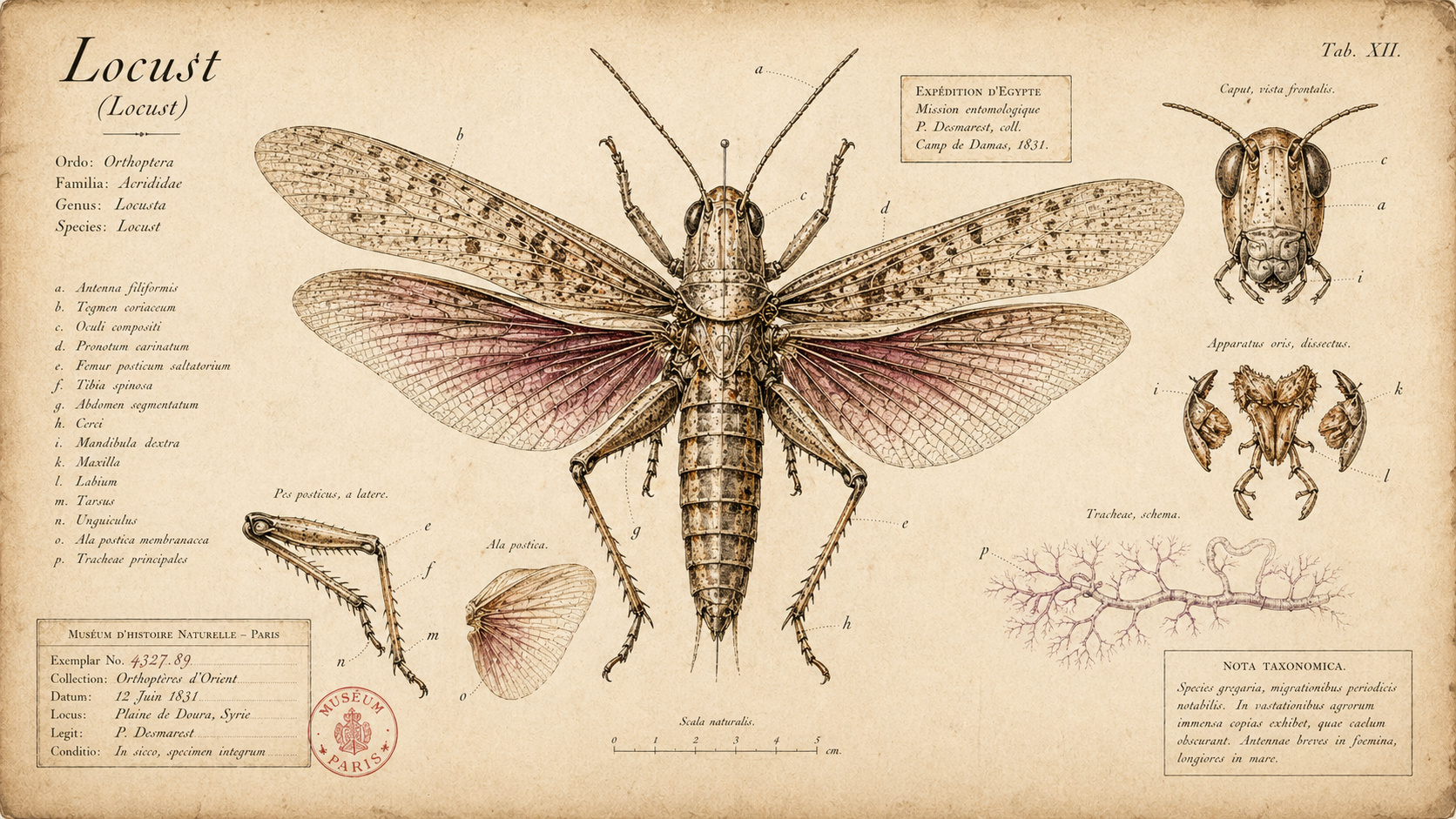
A locust at low population density is solitary, drab and avoidant. It moves alone. It eats locally sourced grass. Crowd them together for a few hours and a different animal emerges. The neurochemistry shifts. Serotonin floods the thoracic ganglia, triggered by the repetitive brushing against each other. Body changes colour. Wing musculature reorganises for sustained flight. The same insect under different conditions becomes a swarmed catastrophe.
If you maintain your grasshopper population low enough, you get the best of both worlds - crops that you can harvest and exchange into cash that funds your further stay in your rural seclusion, and amazing summer evenings filled with chirping sounds.
If you don't...
In 2003 a small population of desert locusts in northwestern Africa survived the dry season in a few green patches near the Mauritanian-Moroccan border. Not bothered by anyone, by 2004 the population had crossed the density threshold. The solitary phase tipped into the gregarious phase. By the time the government response was funded and mobilized, swarms had moved across twenty-three countries, eating through 2.5 billion dollars of crops and requiring nearly half a billion more in control operations.
Locust is not "bad insects do bad things". It is "ordinary insects in ordinary conditions cross a threshold and become a different animal". That is also true for teams.
Grasshoppers
A standup is fine. Planning is fine. Retrospectives are fine. Ticket grooming, change advisory boards, risk registers, architecture review boards. Each, in isolation, created in response to a real need or failure, is fine.
Retrospective was added because the team kept not documenting. CAB was added because we disrupted a service for half a day on a Friday afternoon. Risk register was added because we knew third-party startup can fail on us but no one kept track of it and ARB was added because two teams shipped incompatible designs into production. Every grasshopper in the field is there because the rain came and the ground was fertile and the grass was green so an entirely defensible reason existed for it to be born.
Stack them together and past a certain threshold, they begin to interact. They phase-change, locust-like.
Decisions queue for meetings. People cannot tell you what they own without looking at the board. Tickets referencing tickets that reference tickets are being sent around where the actual problem is buried so deep in the dependency graph nobody can untangle it anymore. Review has a calendar invite, agenda, slide deck and a pre-review meeting to align on it all.
Team lead who last quarter shipped major refactor, fixed cache invalidation bug nobody else could reproduce, onboarded two people, and can sort out design issues for new feature on her way to the coffee machine, didn't get lazy all of a sudden. Team has not lost its judgement. Their contact pattern, on the other hand, changed. Five standups. Two syncs. Refinement. Seven different reports on top of the day. Stacked rituals and processes created a density that crossed a threshold, and the healthy hum transformed into the sound of your crops being eaten.
You can tell which team moves the slowest and it's usually the one that spends most of its energy mapping and fixing their SDLC. There is no villain. No bad person. The team has simply organised its work around the apparatus. This is also why so often attempts to fix it fail. And the inevitable result is that output drops. And the instinctive response, when output drops, is to add yet another layer of control. Another sync. Another check. Another grasshopper that already wreaks havoc in your field.
Every grasshopper has a completely valid reason to be there. The locust is the reasons stacked.
The Hum
Well-oiled team sounds exactly like the field at dusk - rituals running, cadences kept, fires put down. This is what makes the dysfunction so durable. It may be the hum of life. It may be the hum of an apparatus consuming its own crop. The further away you are, the less likely you are to tell the difference. The team that completes reports can be a team that is shipping, or a team that has accepted that reports are now the work. A green dashboard is a field at dusk - easy to mistake for either.
The phase-shift signs are not in the dashboards. They are in the air. Watch a small call take three days because it needed a meeting. A trade-off that now waits for permission, when it used to be resolved over morning coffee. A fuzzy spec that used to land in the garbage now getting meticulously annotated and talked over in a never-ending email chain.
The Porch
When you hear that hum is a bit too much, the right thing to do is usually the counterintuitive one. In the field a farmer reaches for pesticide. There is no pesticide for the flow of your team. You slowly tune the hum back down. A meeting you cancel permanently. A ritual you retire while your team watches you do it. The autonomy to make decisions you hand back to the people without the need to justify themselves. Being able to introduce process is a valuable trait. Being able to remove it is invaluable one.
People around you will proudly tell you all about their well designed processes and try to onboard you to them. Cadences. Dashboards. Their columns all green and their reports all filled. It may be the hum of life. It may be the hum of an apparatus consuming its own crop. If it's the former, copy it. If the latter, be wary of it. The hum is loud either way.
The hum of crickets in the field is what makes life worth living. The same goes for the hum of a healthy team. People talking, decisions made autonomously, small and often, questions answered before they were articulated. Both make the field alive and both have a very fragile balance that keeps it from eating the crop. It's your privilege to sit on a porch and enjoy the hum when it is just right, and your job to hear when the swarm is on its way.
Back to blog